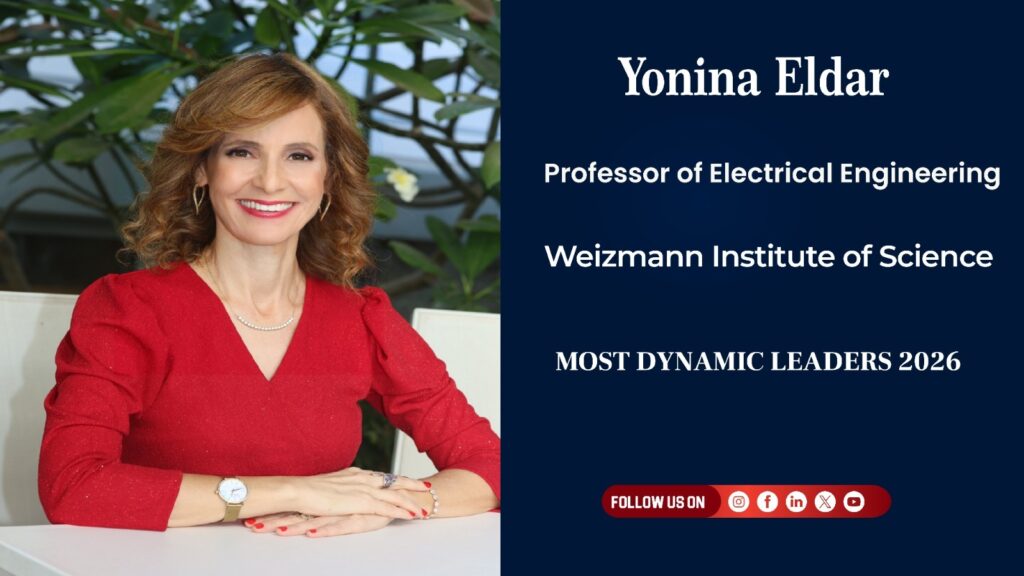
Yonina C. Eldar: Reimagining Signals, Science, and Human Potential
In signal processing, where theory meets real-world systems, Prof. Yonina Eldar has redefined what is possible. Some innovators don’t just push boundaries, they redraw them. Prof. Yonina Eldar is one such visionary. Her journey from a curious student of physics and electrical engineering to one of the world’s foremost thinkers in signal processing exemplifies the power of curiosity, resilience, creativity, and purpose-driven research.
Born in Toronto and raised in Israel, Eldar’s early education was shaped by a deep fascination with both theoretical ideas and practical problems. She pursued a dual degree in physics and electrical engineering at Tel Aviv University, navigating overlapping curricula that demanded persistence and passion. This blend of theory and application became a defining theme of her later work. In addition to her role at the Weizmann Institute of Science, she also holds a position at Northeastern University, further extending her academic and research impact.
After earning her Ph.D. at the Massachusetts Institute of Technology, where she explored the mathematical foundations of signal processing, Eldar faced a choice familiar to many promising researchers: remain in leading academic hubs in the United States or return home to build something new. She chose the latter, coming back to Israel to help shape the future of engineering research.
Her work quickly made an impact. Eldar has challenged long-held assumptions in signal processing, particularly the limits defined by the classical Nyquist–Shannon sampling theorem, by proposing methods that enable accurate recovery of signals from significantly fewer measurements. This idea, often described as understanding structure and sampling smarter, has transformed how engineers design systems ranging from radar and wireless communications to advanced medical imaging technologies.
At the heart of Eldar’s work is a simple yet profound idea: problems can be rethought at their core to yield solutions that are both elegant and practical. Her lab at the Weizmann Institute of Science, the Signal Acquisition, Modeling, Processing and Learning (SAMPL) Lab, embodies this philosophy. It integrates mathematics, artificial intelligence, medical research, and engineering to create technologies that improve human life. Projects range from compact ultrasound devices to radar systems capable of monitoring breathing and heart rate without contact, innovations that bridge fundamental science and real-world impact.
Eldar’s scientific contributions have received broad recognition. She has been awarded numerous prestigious honors, including the 2025 Israel Prize for Engineering and Technology, the highest civilian honor in her country, underscoring both the depth of her research and its societal relevance. She is a member of the Israel Academy of Sciences and Humanities and an IEEE Fellow.
Yet beyond accolades, Eldar’s journey reflects something deeper: the creative power of interdisciplinary thinking and the role of imagination in science. She encourages her students and collaborators to explore connections across mathematics, physics, computation, and biology, mirroring the reality that today’s challenges rarely fit within a single discipline.
Eldar is also a strong advocate for inclusion and diversity in academia, actively working to create opportunities for women and underrepresented groups in science and engineering. This commitment extends her impact far beyond research, shaping a more inclusive and dynamic scientific community.
In an era defined by data, communication, and rapid technological change, Yonina Eldar’s work reminds us that rethinking fundamental assumptions can unlock entirely new capabilities. Her story is not only about scientific excellence, but about curiosity, creativity, and the courage to question what seems fixed. It continues to evolve, pushing both science and society toward new and unexplored possibilities.