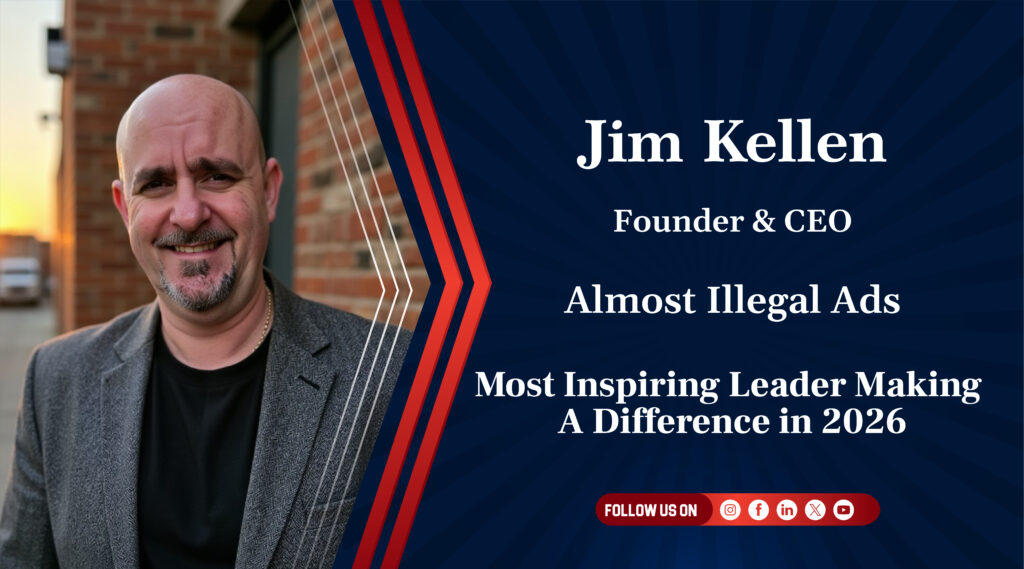
Every Dollar Traceable: How Jim Kellen & Almost Illegal Ads Are Rewriting The Rules Of Legal Marketing
Most marketing agencies report on clicks, impressions, and rankings. Jim Kellen built a company that reports on signed cases, because after twenty years in search marketing, he noticed that nobody could answer the only question business owners actually ask.
Kellen is the founder and CEO of Almost Illegal Ads (AIA), a Sacramento-based search marketing agency that works exclusively with law firms across the United States. Since launching in early 2016, the company has grown from a two-person operation into a team of roughly thirty people spanning SEO, paid search, Local Services Ads, content, analytics, and account management. Every one of those functions is organized around a single standard: a marketing dollar should be traceable from the first click to the signed retainer.
A Question Nobody Could Answer
Before AIA, Kellen spent more than two decades in search marketing, first through his earlier company, Smart Choice IM. Over those years, one conversation kept repeating itself.
“A business owner would show me a report from their agency, full of rankings and impressions and colorful graphs,” Kellen recalls. “Then they’d ask me the only question that mattered to them: ‘So, am I making money?’ And nobody could answer it.”
That question became the company. Kellen launched Almost Illegal Ads in 2016 and built it around law firms specifically, because legal is where the accountability gap costs the most. Legal keywords are among the most expensive clicks on the internet, and a firm spending five or six figures a month deserves to know exactly which campaigns produce clients and which produce noise.
“A ranking that never rings the phone is a trophy, not a result,” Kellen says.
The Name Is A Wink; The Work Is By The Book
The company name gets a reaction, which is by design.
“The joke has always been that when the results are good enough, people assume you must be cheating,” Kellen explains. “We’re not. Everything we do is by the book. But I wanted a name that told attorneys, in three words, that we were not going to be another beige agency sending beige reports.”
Behind the wink sits an unusually strict compliance posture. Legal advertising is governed by state bar rules that vary by jurisdiction, and every AIA campaign is built to comply in each state where a client practices. The same discipline extends to content accuracy. The agency treats a legal error in a client’s blog post as seriously as a lost ranking.
“A blog post that cites an outdated statute is a liability wearing an SEO costume,” Kellen says.
Cost Per Signed Case, Not Cost Per Click
AIA’s methodology connects every layer of a campaign to intake outcomes. Call tracking, form tracking, and intake data tie ad spend to signed cases, so a managing partner can see what each channel costs per client acquired, this month, in one view. Reports are written in plain English, and when a campaign underperforms, the report says so, along with the plan to fix it.
The company also refuses to lock clients into long-term contracts, a decision that shapes its internal culture as much as its sales pitch.
“If a client can leave any month they want, we have to earn our seat every single month,” Kellen says. “Early on, most attorneys who called us had already been burned by an agency. Removing contracts was our way of saying: don’t trust our pitch, trust our next thirty days.”
The results of that policy show up in tenure. Several AIA client relationships have passed the ten-year mark, sustained entirely by monthly performance rather than contractual obligation.
Trust, Persistence & The Contract Nobody Signs
Ask Kellen about leadership and he answers with four words: transparency, persistence, trust, and integrity. They read like poster material until you watch them govern actual decisions, from telling a client the truth about a bad month to hiring people who own outcomes without supervision.
“My job is to hire people who are better than me at their piece of the work and then get out of their way,” he says.
That approach carried the company from two people to a team of about thirty, serving firms nationwide, and in 2026 it gained a physical anchor: a new office at 2014 Capitol Avenue in Midtown Sacramento, giving the agency a home base in California’s capital.
The Bet That Built A Firm: Lincoln-Goldfinch Law
The story Kellen tells most often is about courage as much as marketing. When AIA began working with attorney Kate Lincoln-Goldfinch in 2020, her Austin practice handled both immigration and bankruptcy. Immigration was her calling, but it is also one of the most saturated and expensive legal search markets in the country, and betting the firm on it takes nerve.
AIA started with paid search to prove the funnel, layered in Local Services Ads as the efficiency engine, and then built the SEO and local search foundation that became the firm’s long-term asset. As the pipeline grew predictable, the marketing stopped being a line item and became the ground the business plan stood on.
Then came the part of the story Kellen is proudest of. Rather than letting the bankruptcy practice wither, AIA helped turn it into an asset. The team separated the bankruptcy work into its own entity, moved its lead generation onto a dedicated domain with its own Google Business Profile, and built it a standalone pipeline until it ran as a self-contained business with its own brand, its own leads, and its own books. Then they helped her sell it.
“A practice area you’re winding down is a cost,” Kellen says. “A functioning business with a proven lead engine is something you can sell. Kate’s exit from bankruptcy ended profitably instead of quietly, and the proceeds and the focus both went where her heart already was: immigration.”
From there, Lincoln-Goldfinch committed her firm entirely to immigration, nearly tripled her team, and grew from an Austin practice into a firm serving clients across Texas and beyond. Six years into the partnership, the numbers include more than 43,000 qualified leads, thousands of signed cases, and roughly twelve dollars in tracked revenue for every dollar of media spend.
“The number I love most is the headcount,” Kellen adds. “Every hire represents families getting help.”
Making A Reputation Findable: A Decade With The Medlin Law Firm
The counterpart story runs on a longer clock. The Medlin Law Firm, a criminal defense practice in Fort Worth founded in 1992, came to AIA with a reputation earned across three decades of courtrooms and a distinctly modern problem: someone arrested at 2 a.m. searches on a phone, and the firm that is visible in that moment gets the call.
The partnership began in 2015 and has now run for more than a decade. Over that time, the firm’s organic search traffic has grown roughly fifteenfold, its dependence on paid clicks has fallen by about 95 percent, and the work has been tied to millions of dollars in attributed revenue.
“That firm did not build its reputation through marketing. It was earned in courtrooms,” Kellen says. “Our job, for over ten years now, has been to make that reputation findable. Marketing works when it amplifies something real.”
Marketing For Search Engines That Answer Back
The next chapter of that work is already underway, because search itself is changing. Prospective clients no longer type two-word queries. They ask complete questions, often through voice assistants or AI chat interfaces, and increasingly they receive assembled answers instead of ranked links.
AIA responded by rebuilding client site architecture around conversational question-and-answer content and rich schema markup, so that when an AI engine composes an answer, it cites AIA’s clients as the source. Content strategy shifted with it, pairing deep guides written for humans with concise, structured summaries built for machine consumption. The agency’s in-house models generate outlines, surface emerging subtopics from live query data, and test headlines in minutes rather than weeks, while experienced marketers review everything for judgment and legal accuracy.
“Speed is a competitive advantage. Speed without judgment is just faster mistakes,” Kellen says. “Over the next five years, AI moves from nice-to-have to foundational in legal search marketing. Agencies that treat it as a gimmick will report on traffic. Agencies that build it into their operations will report on revenue.”
Depth Over Width: The Road Ahead
Kellen is direct about what growth means for AIA, and about what it does not mean.
“We could triple revenue tomorrow by taking on restaurants and roofers, and we won’t,” he says. “Our edge comes from knowing one industry completely: its ethics rules, its intake realities, its economics.”
The plan from the new Sacramento headquarters is depth: pushing further into generative engine optimization, deepening the analytics that connect marketing spend to signed cases, and reaching the thousands of law firms still paying for reports that never answer the money question.
Ten years in, the vision has stayed exactly where it started. “I want us to be the agency attorneys name when someone asks who can actually prove their marketing pays for itself,” Kellen says. “Everything we build serves that sentence.”
Pick A Lane & Go Deep: Kellen’s Advice For New Entrepreneurs
Ask Kellen what he’d tell a founder starting out today and the answer sounds a lot like the company he built.
“Pick a lane and go embarrassingly deep,” he says. “The generalist competes with everyone. We chose one industry, and depth turned out to be a moat that gets wider every year you stay in it.”
The second piece is about measurement. “Track what your client’s accountant tracks. If your metric doesn’t connect to their revenue, you’re decorating, and eventually somebody who measures the real thing will take your client.”
The last one is the least intuitive. “Make it easy to fire you. Removing our contracts forced a level of monthly accountability that made the whole company better. Retention became proof instead of a hostage situation.”
Twenty years of search marketing, condensed into three sentences a founder could tape to a monitor. It also happens to be a fairly complete description of Almost Illegal Ads.