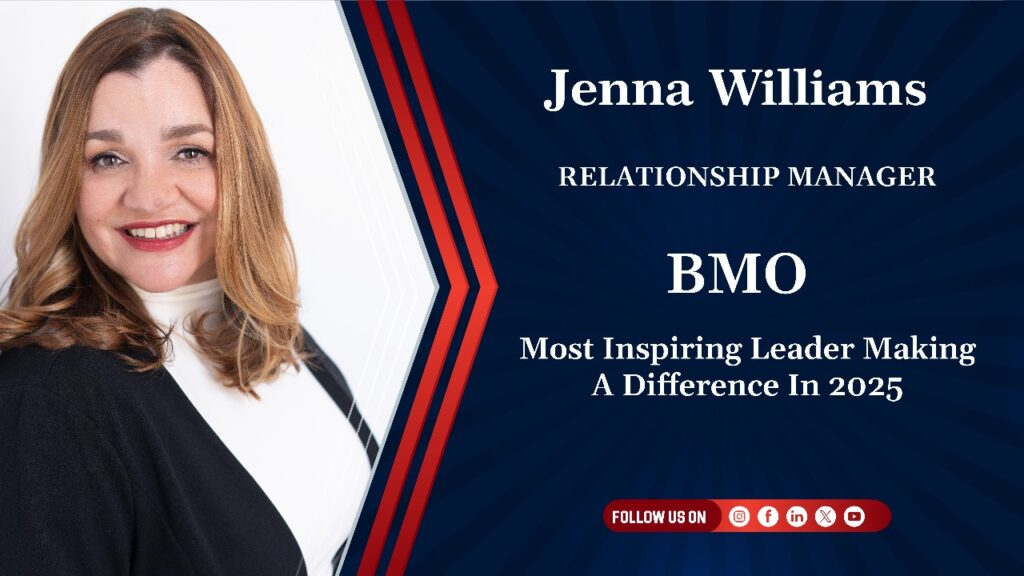
Discover how Jenna Williams, Relationship Manager at BMO, redefines relationship banking through authenticity, empathy, and strategic insight. This in-depth profile explores her journey, client philosophy, and vision for the human side of finance in an era shaped by digital transformation.
In the intricate world of finance, where transactions and numbers often take precedence, relationship banking stands as a transformative force driven by empathy, connection, and strategic foresight. Few exemplify that balance between business acumen and emotional intelligence as well as Jenna Williams, a Relationship Manager with BMO. Working with businesses that generate over $20 million in annual sales, JennaWilliams has built her career around a singular philosophy—understanding people behind the balance sheet.
Her approach extends beyond financial performance to the personal stories and ambitions shaping each enterprise. “My goal is simple,” she explains. “To be a genuine partner and improve the money blueprint.” It is a statement that defines not just her career path but her value system—a belief that sustainable financial success comes from genuine relationships, ethical collaboration, and a deep respect for the human side of commerce.
The Journey into Relationship Banking
Ms. Williams’ entry into banking was not a conventional one. After facing personal upheaval and re-entering the workforce during a divorce, she started in banking in 2007 at ground-level sales work that demanded persistence and sharp interpersonal skills. From there, she evolved into a trusted partner for multimillion-dollar businesses. Her professional ascent was built on curiosity, self-education, and resilience: “I learned all the things I didn’t know, which was a lot,” she admits with humor.
Her humility and tenacity became the foundation of her success. In a profession often associated with rigid metrics and complex regulations, Ms. Williams shaped her own journey through authenticity and connection. Her progression reflects a broader pattern in modern banking—one in which empathy, perseverance, and creativity are becoming just as valuable as traditional technical expertise.
The Rewards and Realities of Relationship Management
For Ms. Williams, the greatest reward in her role is watching her clients thrive. “To see people I have helped succeeding in ways we couldn’t even imagine at our first connection,” she says, “is genuinely fulfilling.” That long-term perspective—where professional relationships transition into trusted partnerships—defines how she sees success.
Yet challenges persist. The modern regulatory landscape, coupled with rapid technological change, makes banking a tightrope walk between compliance and compassion. “The most challenging part is delivering banking with a human approach amid all the regulations,” she explains. “The goal is to make sure customers can focus on their business, not mine.” Her awareness of this delicate balance captures an essential truth of relationship management: the client experience must feel seamless, even when the systems behind it are anything but simple.
Building Trust and Credibility
In industries characterized by scepticism and competition, trust is currency. It doesn’t come from corporate title or brand alone—it comes from consistency and human authenticity. “I focus on being authentically me,” says Ms. Williams. Her two decades of experience are not only measured in revenue growth but in community impact—solving both seen and unforeseen business needs.
Her long-term philosophy centers on track record and integrity. For Jenna, credibility isn’t declared; it’s demonstrated through action. “Follow through is everything,” she emphasizes. “Consistently doing what you say you will do builds the reputation that earns invitations to connect with the right people, places, and things.” This principle of reliability—quiet, steady, and often invisible—is the fabric of trust-based banking.
Digital Transformation and the Human Connection
Amid fintech revolutions and AI-driven analytics, it might seem that emotional connection is becoming secondary to digital precision. Jenna sees it differently. “Technology is super cool—I grew up without the internet and appreciate how fast information is available. But emotional connections are how we form bonds essential for mental and spiritual health. It’s literally what makes us human.”
Her stance reflects a growing sentiment across the industry: automation enhances efficiency, but relationships drive loyalty. In an era where clients can access financial products with a few clicks, the differentiator becomes empathy, understanding, and adaptability. “The digital transformation,” she asserts, “has made the human component more necessary than ever.”
Jenna integrates technology as a support—not a substitute—for her client outreach. Whether through AI-enhanced market insights or digital collaboration tools, her focus remains on maintaining humanity at the center. The next wave of FinTech, she predicts, will not replace bankers—it will amplify those who are relationally intelligent and ethically grounded.
The Power of Authentic Partnership: A Success Story
One of Ms. Williams’ most memorable experiences exemplifies this philosophy. Years ago, she supported a business owner through an SBA loan designed to fund their growth strategy. Five years later, they still connect and collaborate. “The fact that I built a real relationship and have had a seat to the growth journey,” she says, “is personally rewarding.”
This longstanding connection reflects what modern relationship management aspires to achieve: continuity, trust, and shared success. The transaction—a loan—was only the beginning. What sustained the relationship was her continued presence and genuine investment in the client’s future.
Ethical Cross-Selling and Adding Real Value
As banking evolves, cross-selling has often been criticized for prioritizing institutional goals over client needs. Jenna rejects that approach outright. “Add real value and have authentic conversations,” she insists. “Always ask questions—you can easily discover opportunities to improve the relationship.” Her client conversations are exploratory, not prescriptive. The purpose isn’t to push products; it’s to identify alignment between client objectives and available solutions.
Her work at one of the world’s top 10 commercial banks provides her with “a ton of options.” But tools matter less than intent. Through mindful listening and ethical framing, she ensures that every recommendation stems from the client’s best interest—a philosophy increasingly recognized as the future of sustainable banking.
Compliance and Client-Centric Balance
The regulatory web surrounding banking is intricate and ever-changing. Jenna approaches compliance not as an obstacle but as a guiding framework. “Proper planning and communicating expectations,” she says, are the cornerstones of balancing service with risk management. Rather than viewing policy as a limitation, she sees it as structure—something that, when understood and integrated early, allows for confident collaboration.
Her responsibility extends to helping clients navigate these boundaries. The transparency in expectation management—what can be done, how, and when—builds credibility while preventing misunderstandings that could jeopardize the relationship.
Staying Informed and Adaptive
In the fast-paced financial world, information becomes obsolete quickly. Jenna stays current through formal channels within BMO and through informal learning networks. “I spend time with partners that educate me,” she explains. “And I use the services available to me through BMO and my network.”
The combination of internal resources and external collaboration gives her a practical edge. Staying informed isn’t just about consuming data—it’s about contextualizing it to client realities. Her learning strategy mirrors her relational approach: immerse, listen, and translate insights into applicable solutions.
Navigating Difficult Relationships
Every banker encounters clients whose emotions run high—especially when money is involved. “We all know the difficult person that no matter what wishes to argue and point fingers,” Jenna notes. Her conflict-management philosophy is rooted in empathy and composure: “I believe you can be firm in your position while being soft in your humanity.” The art lies in bridging perceptions—understanding what outcome the client wants and aligning it with institutional possibilities.
That mindset turns potential crises into trust-building opportunities. By focusing on mutual understanding rather than zero-sum confrontation, she often diffuses tension and earns respect. These experiences reinforce how emotional intelligence and self-regulation can be decisive skill sets in financial services.
Emotional Intelligence as a Professional Superpower
EQ—the ability to perceive, interpret, and manage emotion—is central to Jenna’s success. She actively cultivates it through reading, trainings, and personal reflection. “I believe being female is my superpower for this skill,” she says. “Empathy provides the neutral point that allows me to self-regulate, no matter how difficult it might seem—and it’s difficult more than I would like it to be!”
This authenticity around personal growth resonates deeply in industries where stress and precision dominate. Emotional intelligence isn’t an innate trait; it’s practiced daily. For Jenna, it’s the professional muscle that keeps relationships resilient and responsive.
Measuring Success Beyond KPIs
While banking is driven by quantitative metrics, Jenna takes a qualitative view. “Success to me is measured by the success of my relationships,” she explains. To her, trust and resilience—how well clients endure unexpected shocks—are more meaningful indicators than quarterly profits or retention rates.
This people-centered KPI redefines value creation. “All businesses have their KPI to achieve,” she says, “but my version is resilience and trust.” The long game is not in transaction volume but in relationship endurance. Her clients’ ability to recover and evolve becomes a reflection of her own impact.
Guidance for Aspiring Relationship Managers
Jenna’s mentorship perspective is candid and compassionate. “Find your peaceful place and guard it with all you have,” she advises. “Understand the demands will be overwhelming more often than not—focus on what you can control.” Her counsel captures both the professional and psychological reality of client-facing banking. Beyond the technical demands, emotional sustainability becomes essential. Her final advice is simple yet profound: “Be a good human being first. Under promise and over deliver—don’t get that backwards.”
This mindset extends far beyond banking. It represents a principle of leadership grounded not in title but in trust—an ethos for anyone managing relationships in complex ecosystems.
Future of Relationship Banking: Humanity Meets AI
Looking ahead, Jenna anticipates an accelerated convergence of technology and regulation. “I believe regulations will make things more difficult, and technology will catch up,” she says. Yet she welcomes the evolution: “AI will play a huge role in business and it will come faster than we can imagine. People want people—not software—to talk to, yet it will make business more efficient.”
Her optimism is tempered with realism. The future of banking won’t be a choice between humans and machines, but a synthesis of both. Those who merge empathy with technological literacy will define the next generation of relationship management.
What Clients Often Miss: Cash Flow as the Lifeblood
Jenna closes with a fundamental observation: “Cash flow and why it matters.” She asserts that cash flow—often misunderstood by entrepreneurs—represents far more than liquidity. It signals health, creditworthiness, and sustainability. “It determines your access to credit and how lenders view your entity,” she explains. For her, educating clients on this core concept is an act of empowerment—helping them translate numbers into strategic decisions.
The Modern Blueprint of Relationship Banking
Jenna Williams redefines the archetype of the modern banker. Her philosophy centers on authenticity, empathy, and continuous learning—a belief that business success begins with trust and that financial partnership means human partnership first.
Her story is not just about banking; it’s about resilience and the pursuit of meaningful impact. In an era shaped by algorithms and automation, Jenna reminds us that relationships remain the true ROI—the foundation upon which the future of banking will continue to be built.