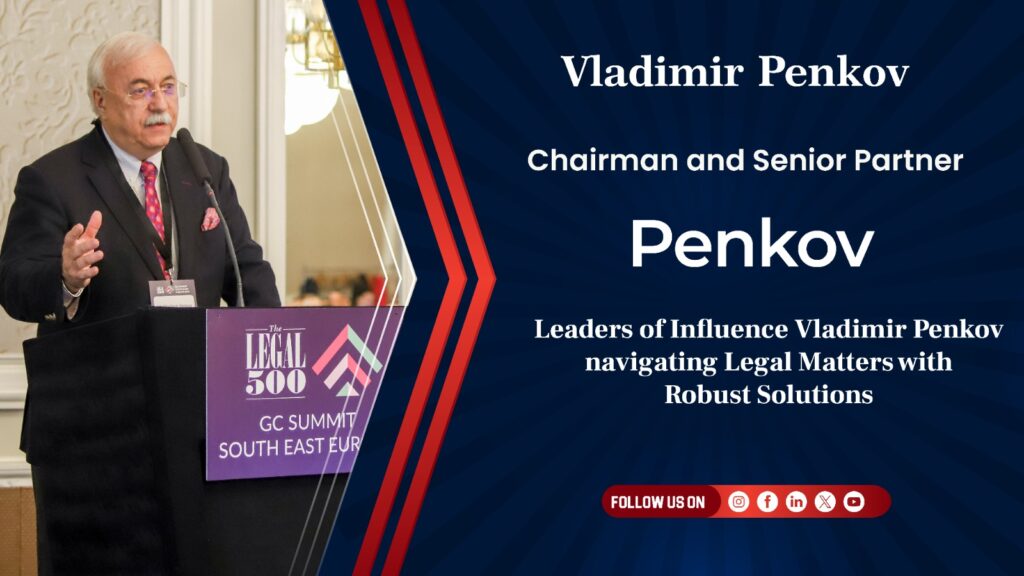
- You founded Penkov, Markov & Partners in 1990 and led it as Managing Partner for 30 years before becoming Chairman & Senior Partner. What has been the single most defining moment in your leadership journey?
Looking back, I cannot help, but reflect on three important starting moments. Of course, firstly the very creation of the law firm at a time when I was still a state employee coming from a socialist system, without experience, but armed with great willingness, faith, and, of course, acquired knowledge.
Second, finding colleagues who, under these circumstances, believed in me and were willing to follow me.
Third, beginning from an office in my own personal flat, which my four-member family and I left for this purpose, and developing from there into a modern office with the most up-to-date equipment and excellent conditions for work and rest.
I would note as a fourth, but not less important point, the implementation of reforms and adaptations in the management and work organization that help colleagues stay motivated, have visions, work as a team, and enjoy their workplace.
And yes, to be proud that we work together at PM&P.
- Your practice spans corporate & commercial law, foreign investments, banking/finance, tax, energy and telecommunications. How do you stay current across such diverse and rapidly evolving fields?
Indeed, PM&P covers practically all spheres of business and investment.
Compared with the well-known law firms in the large world economies, we are a small, rather boutique firm. Therefore, every lawyer must not only cover 3-4 areas of law, but must also be a good specialist in them.
For the more important law fields, we have established permanent specialized working groups in the various spheres, led by the most experienced specialists.
Within these groups, new developments are regularly discussed and knowledge is updated, while collective experience is gathered.
Our internal organization encourages every colleague to stay motivated to constantly improve – this is an important reserve.
In this way, we always manage to remain at the highest level.
Teamwork and mutual support further strengthen and develop this high level, ensuring that clients receive the best possible advice.
- In your experience, what are the major legal and regulatory challenges foreign investors face when entering the Bulgarian market today?
For EU citizens, almost all restrictions based on this ground (nationality) have been reduced to a minimum, whereby they can freely purchase residential property and land, establish companies, and carry out business activities.
For citizens outside the EU, there are still some restrictions regarding the acquisition of land, but they have free access to establishing companies and conducting business activities. They must also obtain a residence right.
For all investors, however, the doors are open, and they are supported by the state through legislation, administrative aid, and even financial support.
- You have contributed to drafting legislative acts in commercial law, energy, taxation and investment regime. What motivated you to become involved in shaping law‑making, and what has surprised you most in that process?
The establishment of free market relations and the introduction of free entrepreneurship after the political changes were a real challenge, which at times encountered reluctance, but also a lack of understanding of the issue by the authorities.
Having worked for many years with institutions such as the BCCI (Bulgarian Chamber of Commerce and Industry) as Vice President, I not only understood what should be done, but also how to help the business through non-governmental organizations.
My desire for Bulgaria to become an attractive country not only for its citizens, but also for investors led me to use my knowledge to support changes in those laws that most directly influence the investment climate and stimulate entrepreneurial activity.
And my work at PM&P has always been directed towards public causes and support of all non-governmental organizations that serve businesses in good faith.
- Having served as Vice President of the Bulgarian Chamber of Commerce and Industry (BCCI) and held board roles in major companies, how has your corporate governance experience influenced your approach to advising clients?
Without any doubt, my service as Vice President of the largest business organization and as a member of supervisory and management bodies in large enterprises has given me not only knowledge and experience, but also the necessary sensitivity to the real problems and expectations of companies related to their better functioning and development.
This, together with my experience in writing draft laws, directly influenced my subsequent engagement and participation in over 30 legislative projects in the areas of investment, commercial law, digital company registrations, taxation, waste processing and others.
- The energy sector in Bulgaria is a key area of your focus. What are the biggest opportunities and risks you see for legal practitioners and investors in the region’s energy transition?
Energy, traditionally the strongest sector in the region, is an important part of the Bulgarian economy. Therefore, the changes in recent years, caused by the Green Deal and the development of new technologies, represent both a challenge and an opportunity for the country’s positioning.
After the closure of the four nuclear reactors and the currently limited capacity of the remaining two reactors, the risks are connected with ensuring balancing power within the strong development of photovoltaics, especially considering the legal obstacles created for the introduction of wind power on grounds such as compatibility, zoning procedures and aviation restrictions.
Hydropower plants and pumped-storage plants, in turn, are becoming problematic because of the lack of sufficient amount of water in the region.
Opportunities are emerging for the development of battery systems, with one 150 MW battery already built in Bulgaria. It is planned that by 2034 the capacity will increase to 5,000 MW, which would be sufficient for balancing capacity. The risks in this regard are related to the lack of voltage equalization during switching, as well as the still relatively short battery life.
Therefore, in view of the still high cost of small modular reactors and the lack of possibilities for securing sufficient gas supply, it will be necessary to maintain balancing capacity in at least one of the so-called American power plants – the Maritsa nuclear power plant with a capacity of 380 MW.
A major challenge for legal practitioners is the inadequate legal framework, which does not envisage monopolies to provide routes for transmission infrastructure, nor does it ensure that every consumer pays proportionally for the infrastructure used to deliver electricity.
Because of all this, there is a great portion of work ahead!
- Competition and antitrust law are among your practice areas. Can you share a recent case or trend in Bulgaria where this area has had a significant impact?
Over the past 3-4 years, our team has been primarily engaged in a number of significant transactions, all of which mandatorily required conducting procedures before the Competition Protection Commission (CPC).
We acted as legal advisors to the seller in the largest transaction in Bulgaria’s energy sector in the past 15 years – the acquisition by Eurohold, through its subsidiary Eastern European Electric Company, of 67% of Bulgaria’s largest electricity distribution company, CEZ Distribution Bulgaria (40% market share), and CEZ Electro Bulgaria, as well as 100% of the capital of CEZ Trade Bulgaria – the largest electricity trader in the country.
This was the largest deal in the Bulgarian energy sector, making it necessary to carry out a complex approval process before the regulatory authorities.
Other notable transactions were in the IT sector and in the field of renewable energy sources.
We were engaged by all shareholders in the sale of Fidelis Research, whereas, together with PricewaterhouseCoopers acting as financial advisors, we structured the entire transaction, took part in selecting a potential buyer, and led the negotiations. We also developed the strategy for selling the business across the different jurisdictions. The buyer was BioIVT, part of the Linden Investment Group.
We also advised the owner of I&G Insurance Brokers (Unilink Bulgaria) in the acquisition of its main competitor, SDI, in the insurance sector.
We provided full legal support to Bulgaria’s leading pension insurance company, Pension Social-Insurance Company Doverie – having assets of over EUR 9 million and being owned by Wiener Städtische Versicherung, in the sale of 10% of its shares to IFC.
In this connection, we structured the data room and conducted negotiations on all documents essential to the transaction. We were also involved in certain regulatory aspects, and, given the significant public interest, we managed communications with various agencies and government bodies.
We were further entrusted with drafting a number of new policies, including those concerning the activity of supervisory and management boards.
We also provided full legal assistance to Optics Factory (in Bulgarian – „Завод за оптика“) part of the Opticoelectron group, in the transaction with Carl Zeiss Jena, which in the first phase is acquiring 31.5% of the shares with options for obtaining international participation after three years.
The transaction was approved by the CPC in July 2025 and was finalized in September 2025.
- For young lawyers or law firms aspiring to build a regional footprint like yours, what three strategic actions would you recommend?
I may be overlooking something, but in any case, first of all, solid professional preparation is essential, next – a high level of communicativeness and active participation in public life through articles, interviews, conferences, seminars and other forums where one can present positions and build his own reputation and that of PM&P.
Last, but not least, I would place honesty, engagement and persistence in the work, so that clients feel they can rely on their issues being resolved in the best possible manner.
- How has the legal services business changed in Bulgaria and Southeast Europe over the last decade, and how is your firm adapting to those changes?
In the early years, when detailed legal reform was still missing and without a commercial law and regulatory framework for investments, our firm, and probably the other firms in Southeast Europe as well, focused their efforts on the process of privatization of state enterprises under the special law on privatizations.
At present, we have a fully developed legal system, a commercial law, an investment law, and a digitalized registry system, and as a consequence now the core of the legal work has shifted to the actual servicing of private enterprises and the relations between them.
Today, our law firm covers all areas of law connected to the business.
The matters related to regulatory compliance have gained new importance, as have personal data protection and measures against money laundering.
- With the rise of digitalisation, cybersecurity and data protection, how do you see these areas reshaping legal practice—and what is your firm doing to be ahead of the curve?
More than 15 years ago, we were already innovators and introduced within the firm our own fully digitalised intranet system, recording all legal consultations, each colleague’s contribution, and the payments due.
In addition, we fully digitalised our accounting, whereby for both systems we maintain the latest security protections.
These two systems significantly relieve colleagues of non-core tasks so that they can concentrate on their essential work, without needing to think about cybersecurity and data protection.
We are now trying to define how and to what extent we can use AI, without taking away the obligation for personal review and assessment by lawyers, and for considering our good practices.
In this way, we combine digitalisation, cybersecurity and data protection into one, which creates convenience for colleagues and builds trust with our clients.
- Reflecting on your awards (e.g., Lawyer of the Year, Senior Statesperson) and recognitions – what do those honours mean to you personally, and how do they shape the firm’s culture?
Of course, these awards not only bring me personal joy, but they also represent a recognition for the entire firm and all our colleagues.
I believe that such awards help us realize that only by observing the highest professional and ethical standards can we count on lasting establishment, trust, and respect.
And these are so important for the success of our business and for providing legal services to our clients.
- You have held leadership roles both in private practice and in corporate boards. How do those roles differ in terms of decision‑making, accountability and risk?
In corporate boards, once discussions are held, a decision is taken and afterwards everyone, at all levels, has to follow it strictly, regardless of whether the decision is optimal.
In private practices (our law firm for example) the decision-making procedure is more complex and involves further exchange of views and explanations, and goes through the process of convincing and achieving genuine internal motivation among all colleagues.
The free professions do not observe orders and decisions that have not been communicated beforehand and afterwards, and for which there is no internal conviction that they are the correct ones.
- In your view, what is the role of law firms in promoting business ethics, transparency and sustainable investment in emerging markets?
I am convinced that law firms play an enormous role in establishing commercial ethics, transparency, and continuous development in new areas of market development.
Through personal example, strict compliance with the law and the good practices, we help maintain discipline in the business entities, respectively – their management boards, which are serviced by us.
- Looking to the future: where do you see the Bulgarian legal and investment landscape in five to ten years, and what should firms prepare for now?
I would like to believe that in five to ten years the judicial reform will have led to a more fair and predictable justice, and to restored confidence among citizens and businesses; that a commercial court will finally be established – a specialised court dealing exclusively with disputes between commercial entities, which have major specifics and differ greatly from disputes between private individuals.
I also expect that legislation concerning the various permitting regimes will develop in a way that deadlines will no longer be merely instructive, but final, and that the “tacit consent” and the removal of unnecessary bureaucratic obstacles will create a boom in entrepreneurial activity, enabling the economy to grow at a much faster pace.
Law firms, for their part, must create the necessary organisational conditions, both regarding the specialisation of lawyers and the optimisation of their number.
Teamwork must replace individualism.
- Finally, what legacy would you like to leave—both personally and professionally—through your work at Penkov, Markov & Partners and within the broader legal community?
When the law firm was founded, I did not think about such a question at all – I simply used all my knowledge, experience, and persistence to carry out this endeavor.
Indeed, at the end of my career, I am confronted with this question ever more often, and I have truly begun to ask myself what will remain in a lasting way.
I believe that what will remain is the example of high professional preparation, the system for development through establishment of a structured managerial approach, the integrity and ethics in our work and in our relations with clients, and also within the office. That “I” is always less than “we”, and that only through the joint efforts of all colleagues can great results be achieved.
I would like something of this to have left a mark and to be recognizable in the broader legal community, which will encourage the younger colleagues.